Account Question or Service Request on a B2B Line?
When an incoming B2B call connects, knowing whether the caller needs an administrative account review or active service work prevents costly misroutes and protects team focus.
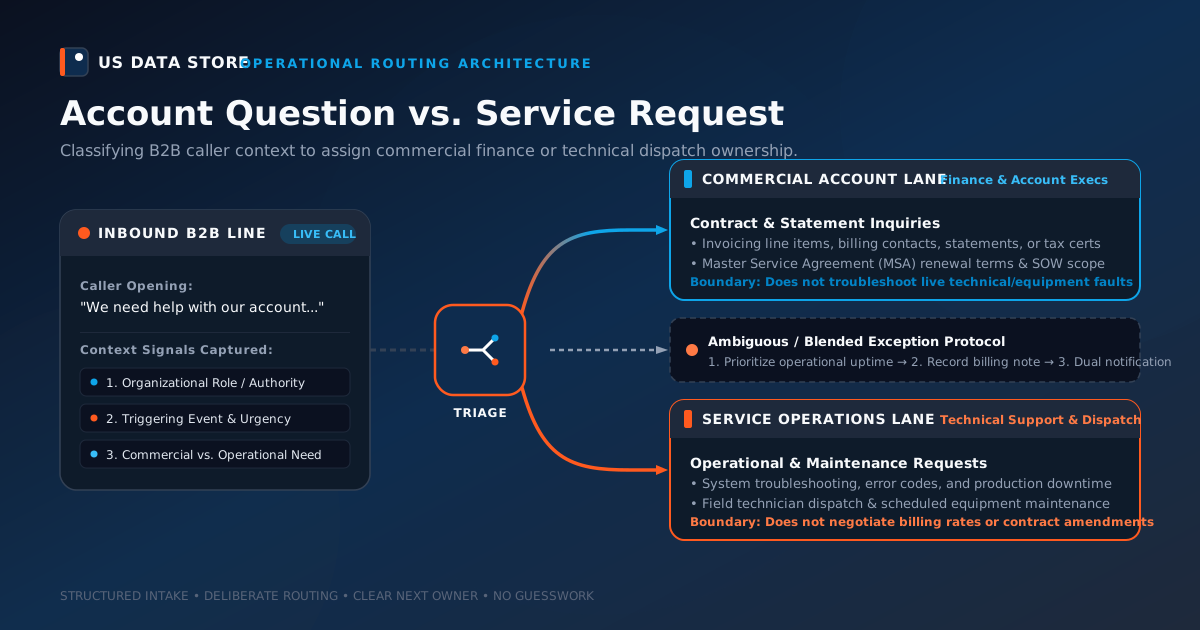
When an incoming B2B call arrives on a busy company line, the person or system answering has only a few moments to determine where that conversation belongs. In business-to-business operations, routing mistakes carry real friction: an account executive is pulled away from strategic renewals to troubleshoot an operational glitch, or a field service engineer is asked to explain a pro-rated invoice discrepancy they have never seen.
Both callers began with a polite request for “help with our account,” but their actual operational needs could not be more different.
The direct answer is that a B2B service operations manager distinguishes an account question from a service request by identifying whether the caller’s primary objective concerns commercial terms and administrative records (an account question) or operational delivery, system status, and technical execution (a service request). Inbound account inquiries must be routed to commercial account management or billing operations, while service requests belong to technical support or operational dispatch. When a caller’s intent is ambiguous or blends both needs, the intake process must capture structured context, separate the immediate operational problem from the commercial concern, and route the call to a human triage owner rather than guessing.
Establishing this classification does not require complex internal software integration, live database lookup, or rigid automated answering trees. It requires defining the specific context cues that identify each request type, assigning unambiguous team ownership, and establishing an exception protocol for the calls that fall between the lines.
1. Which caller context identifies the type of request?
Callers rarely introduce themselves using internal departmental terminology. A client experiencing a system failure might call and ask, “Who handles our account? We have a problem.” If front-line intake routes that call based solely on the word “account,” it lands on the commercial desk while production remains stalled.
To classify calls accurately during intake, the front line should evaluate three distinct context signals: the caller’s organizational role, the triggering event, and the specific subject matter requested.
Signals of an Account Question
An account question centers on the contractual, financial, or administrative relationship between the two businesses. The caller is typically looking at documentation rather than interacting with the working product or active service.
- Caller role: Accounts payable specialist, procurement manager, corporate controller, vendor management coordinator, or primary business signatory.
- Triggering event: Receipt of a monthly invoice, an approaching annual renewal date, a vendor compliance audit, an internal corporate reorganization, or a planned budget review.
- Core subject matter:
- Invoice line items, payment remittance details, billing addresses, or tax exemption certificates.
- Master Service Agreement (MSA) terms, contract renewal milestones, or statement of work (SOW) amendments.
- Adding or removing authorized corporate points of contact or billing signatories.
- High-level subscription licensing tiers or baseline contracted service scope.
Signals of a Service Request
A service request centers on operational continuity, task execution, performance issues, or practical day-to-day delivery. The caller is typically experiencing a roadblock in their active workflow.
- Caller role: Operational end user, field supervisor, warehouse operations lead, system administrator, or project coordinator.
- Triggering event: An equipment fault, software error message, missed scheduled pickup, operational bottleneck, or routine preventative maintenance window.
- Core subject matter:
- Technical troubleshooting, system downtime, performance degradation, or error logs.
- Scheduling on-site field maintenance, technician visits, or physical hardware repairs.
- Operational configuration changes required for daily business tasks.
- Requesting immediate assistance to restore an interrupted business workflow.
Initial triage questions
When a caller’s opening statement is broad, two focused questions quickly surface the underlying context:
- “Are you calling about an invoice, contract, or account administration, or are you needing assistance with active service, equipment, or technical support?”
- “Is this inquiry related to a specific operational issue or job currently in progress, or is it an administrative question for your account manager?”
These questions allow the caller to self-identify their need before any transfer occurs, preventing internal ping-pong between departments.
2. Which receiving team owns the next step?
Once the request type is identified, team ownership must be absolute. Routing failures often occur not because intake failed to categorize the call, but because internal teams pass responsibility back and forth.
Incoming B2B Call Intake
         │
         ▼
┌─────────────────────────┐
│ Identify Caller Context │
└────────────┬────────────┘
             │
   ──────────┴──────────
  │                     │
  ▼                     ▼
[Account Question]     [Service Request]
  │                     │
  ▼                     ▼
Commercial Lane        Technical Lane
• Invoicing & Billing  • Incident Triage
• Contract & SOW       • Technical Support
• Account Manager      • Field Dispatch
The Commercial Account Lane: Account Management & Finance
The commercial lane owns all conversations related to commercial terms, billing health, contract changes, and executive stakeholder alignment.
- Primary owners: Dedicated Account Managers (AMs), Customer Success Managers (CSMs), or the Commercial Billing / Accounts Receivable team.
- Standard next actions:
- Reviewing contractual terms, rate cards, or active payment records.
- Reissuing statements, updating billing contact details, or clarifying invoice calculations.
- Initiating contract amendment discussions or scheduling formal account review meetings.
- Operating boundary: Commercial teams must never attempt to diagnose technical defects, promise undocumented engineering fixes, or modify operational dispatch queues without technical coordination.
The Operational Service Lane: Technical Support & Dispatch
The service lane owns operational performance, incident resolution, scheduled maintenance, and technical execution.
- Primary owners: Technical Support Desk, Service Operations Center, Field Dispatchers, or Application Tier Specialists.
- Standard next actions:
- Triaging reported operational symptoms and assessing incident severity.
- Gathering environment specifications, error codes, and impacted asset IDs.
- Dispatching field technical resources or initiating standard remediation workflows.
- Operating boundary: Technical service teams must never negotiate contract pricing, issue billing credits, promise legal contract modifications, or interpret MSA liability clauses during a support conversation.
The handoff standard
A successful handoff transfers the structured context gathered at intake, not merely a live voice connection. The receiving team should receive the caller’s verified name, company name, direct callback number, stated reason for the call, and whether any immediate operational deadline exists. This ensures the receiving specialist begins the conversation with immediate operational awareness.
3. Buyer-Side Classification Worksheet
To establish clean boundaries across your inbound phone line, service operations managers can use the following classification worksheet to train front-line staff and align internal receiving teams:
| Caller Context & Signal | Initial Classification | Primary Receiving Team | Essential Context to Capture | Operational Boundary / Hand-off Rule |
|---|---|---|---|---|
| Invoice / Payment Inquiry Caller questions a line item, seeks payment verification, or requests updated W-9 / tax records. |
Account Question | Accounts Receivable / Commercial Billing | Caller name, company, invoice number, specific charge in question, callback phone. | Do not debate disputed amounts on the phone; route to billing specialist with invoice reference. |
| Contract / Renewal Discussion Caller asks to review annual agreement terms, licensing tiers, or MSA renewal milestones. |
Account Question | Dedicated Account Executive / CSM | Caller name, company, contract ID, renewal timeframe, decision-maker status. | Route directly to assigned account owner; do not provide off-hand pricing estimates. |
| Authorized Contact Change Caller needs to add or remove billing recipients or administrative account owners. |
Account Question | Account Operations / Customer Success | Caller name, company, requesting authority, details of contact to update. | Require documented verification per company policy before updating master records. |
| System Outage / Service Disruption Caller reports operational blockage, offline tool, or halted workflow. |
Service Request | Technical Support Desk / Operations | Caller name, company, affected system/asset, operational impact, error messages. | Treat as operational priority; gather diagnostic context immediately; do not route to sales. |
| Scheduled Maintenance / Dispatch Caller requests routine equipment servicing, inspection, or field technician visit. |
Service Request | Field Service Dispatch / Support Scheduling | Caller name, company, site location, asset ID, preferred service window. | Confirm service request details; verify site access constraints before scheduling dispatch. |
| Configuration / Technical Question Caller asks how to adjust system settings, permissions, or routine feature workflows. |
Service Request | Tier 1 Support Desk / Knowledge Team | Caller name, company, user role, specific workflow or setting in question. | Connect with technical support specialist; avoid pulling commercial reps into operational walkthroughs. |
(Operational note: This worksheet is a buyer-side operational planning aid. US Data Store provides structured inbound call handling, caller context intake, and business-defined routing; it does not perform automated internal database lookup, live CRM/ERP account record extraction, automated ticket creation, or guaranteed SLA response times.)
4. What to do when caller intent is ambiguous or blended
In real-world B2B operations, callers often present ambiguous or hybrid requests. A client might call during a production halt and say:
“Our packaging line is down because your software faulted, and we refuse to pay last month’s invoice until this is fixed.”
This call contains both an urgent technical service request (line down) and a commercial account dispute (withheld invoice payment). Forcing the caller to choose a single lane without guidance creates immediate frustration.
To resolve ambiguous or blended calls, service operations managers should implement a three-step triage protocol:
Ambiguous or Blended Inbound Call
               │
               ▼
┌──────────────────────────────┐
│ 1. Prioritize Operational    │
│    Continuity First          │
└──────────────┬───────────────┘
               │
               ▼
┌──────────────────────────────┐
│ 2. Document Commercial Claim │
│    as Associated Context     │
└──────────────┬───────────────┘
               │
               ▼
┌──────────────────────────────┐
│ 3. Route to Technical Desk   │
│    with Flag to Commercial   │
└──────────────────────────────┘
Step 1: Prioritize operational continuity first
Whenever an ambiguous call includes an active service impediment, operational recovery always takes precedence over administrative accounting. An unaddressed system failure compounds financial damage every hour it persists, whereas an invoice dispute can be methodically resolved once systems are stable.
- Front-line phrasing: “I understand this issue is impacting your active operations and that there is a related billing concern. Let’s first connect you with our technical team to address the operational halt, and we will make sure your account manager receives full notes on the invoice question.”
Step 2: Document the commercial concern as context, not resolution
During intake, capture the caller’s commercial complaint accurately without validating or disputing liability:
- Note: “Caller states June invoice #4821 is disputed due to today’s line interruption.”
- Capture the specific invoice number, the caller’s stated reason, and their commercial contact.
- Do not attempt to negotiate credits, waive fees, or interpret contract penalty clauses during intake.
Step 3: Route to the operational owner with a flagged commercial copy
Transfer or dispatch the call to the Technical Support Desk so troubleshooting begins immediately. Simultaneously, route the documented commercial context to the assigned Account Manager. When the technician completes the operational triage, the account manager already possesses the background necessary to address the commercial discussion with complete situational context.
What to do when intent remains completely unclear
Occasionally, a caller is unable to articulate their need—such as an assistant relaying an urgent executive message without technical details. In these cases:
- Capture four foundational details: Caller Name, Company Name, Direct Phone Number, and Best Availability Window.
- Record the verbatim message without summarizing or assuming intent.
- Route the message to an internal Human Triage Coordinator or Lead Operations Desk rather than a specialized engineer or sales representative.
- The triage coordinator reviews the company’s account file and conducts a preliminary callback to clarify the requirement before dispatching internal resources.
5. Illustrative Scenario: Managing Inbound Routing for a Mid-Size B2B Equipment & Logistics Firm
Illustrative Scenario
The following scenario illustrates how a mid-size B2B commercial equipment and logistics company organizes its inbound phone intake between account management and service operations. It is provided strictly for operational planning illustration and does not represent a specific customer, live transcript, or guaranteed business outcome.
Apex Industrial Solutions provides automated material handling systems and preventive maintenance services to manufacturing plants across the Midwest. During morning operating hours, Apex receives high inbound call volume spanning routine billing questions, emergency system breakdowns, and scheduled service requests.
Previously, Apex used a generic phone tree that offered two ambiguous buttons: “Press 1 for Customer Service, Press 2 for Operations.” Callers routinely pressed whatever option they reached first. Service technicians spent their mornings answering questions about freight invoicing, while account managers scrambled to understand urgent machinery fault codes.
To resolve this operational confusion, Apex implemented clean intake rules across their primary phone line:
Test Call 1: The Commercial Invoicing Inquiry
- Caller: Procurement Director at a major regional distribution facility.
- Initial statement: “I need someone to review our quarterly account summary. There’s an unexplained surcharge on last month’s statement.”
- Intake assessment: The caller is a procurement director referencing financial statements and billing calculations. There is no active operational downtime.
- Action taken: The intake agent categorized the call as an Account Question. The agent captured the director’s name, facility account number, the invoice date in question, and their callback extension.
- Receiving team: Commercial Billing / Accounts Receivable.
- Result: The billing specialist pulled the contract rate schedule, identified a freight adjustment clause, and contacted the procurement director within their standard review cycle with the exact contract backup.
Test Call 2: The Urgent Equipment Service Request
- Caller: Shift Supervisor at an automotive parts stamping plant.
- Initial statement: “Our hydraulic lift unit on Conveyor Line 3 is throwing error code E-402 and the belt has stopped.”
- Intake assessment: The caller is an on-site supervisor reporting active machinery stoppage and an operational fault code. This is an operational priority.
- Action taken: The intake agent immediately categorized the call as a Service Request. The agent recorded the facility location, equipment serial number, the specific fault code (“E-402”), and confirmed that the line was completely stopped.
- Receiving team: Technical Service Desk & Field Dispatch.
- Result: The on-call technical support lead received the full diagnostic context before picking up the line, immediately reviewed the hydraulic pressure schematics, and dispatched a local field technician with the correct replacement valve already loaded.
Test Call 3: The Ambiguous Blended Inquiry
- Caller: General Manager at a mid-size distribution hub.
- Initial statement: “We need to cancel our service contract because your technician was three hours late yesterday and our morning shift was ruined.”
- Intake assessment: The call blends operational frustration (delayed technician) with a serious commercial threat (contract cancellation).
- Action taken: The intake agent applied the triage protocol: acknowledging the operational disruption while documenting the commercial context. The agent captured the work order number from yesterday’s visit, the caller’s specific complaint, and their direct mobile number.
- Receiving team: Primary handoff to the Senior Customer Operations Manager, with an automated notification sent directly to the Director of Account Management.
- Result: The Operations Manager called back with direct knowledge of yesterday’s technician dispatch log, addressed the root cause of the delay, and briefed the account executive so that contract renewal discussions could proceed on an informed, constructive basis.
6. Structuring B2B Intake with US Data Store
Established B2B companies require phone answering that reflects the professional complexity of their business. US Data Store is designed specifically for mid-market and growing commercial teams whose inbound call volume has outgrown a simple reception line.
- Always-on business response: Provides 24/7 inbound answering that handles incoming calls with your company’s greeting and business identity.
- Context-rich inquiry intake: Collects structured caller context—including company details, operational urgency, and specific inquiry subject matter—as outlined in our first-call checklist.
- Deliberate team routing: Directs callers toward the appropriate internal lane (commercial account management or technical service operations) based on your business’s agreed workflow, supporting the principles described in our guide to routing B2B service calls with context.
- Structured human escalation: Connects high-priority operational calls or complex blended inquiries to designated human owners or live handoffs following the rules you establish.
Straightforward onboarding and commercial terms
US Data Store operates with transparent pricing and structured implementation tailored to B2B teams:
- Sales-assisted initial setup: A sales agent works directly with your team to configure your initial call flow, define your routing rules, and establish your account versus service intake boundaries.
- In-platform ongoing edits: You maintain full flexibility to adjust your routing logic, team destinations, and intake questions directly in the platform, with support available for additional guidance.
- Predictable monthly subscription: The standard AI Phone Agent subscription is $199 per month, billed month to month, with $0 setup or onboarding fees.
- Included usage allowances: Each monthly billing period includes 500 inbound voice minutes and 500 SMS text messages. Additional usage is billed at $0.12 per additional minute and $0.02 per additional SMS.
- Flexible cancellation: You can cancel before the end of the current billing period to prevent renewal. Service remains active through the paid period, and overage charges already incurred remain due. Refunds for prepaid monthly service are evaluated case by case per our Terms of Service.
Give your team the clarity it needs and ensure your callers reach the right desk every time. Explore How It Works, review our FAQ, or book a walkthrough with US Data Store today.