Keep Service-Case Contact Separate From Sales Outreach
Keep B2B service-case updates and later sales approaches distinct, with a practical handoff example and contact-review questions.
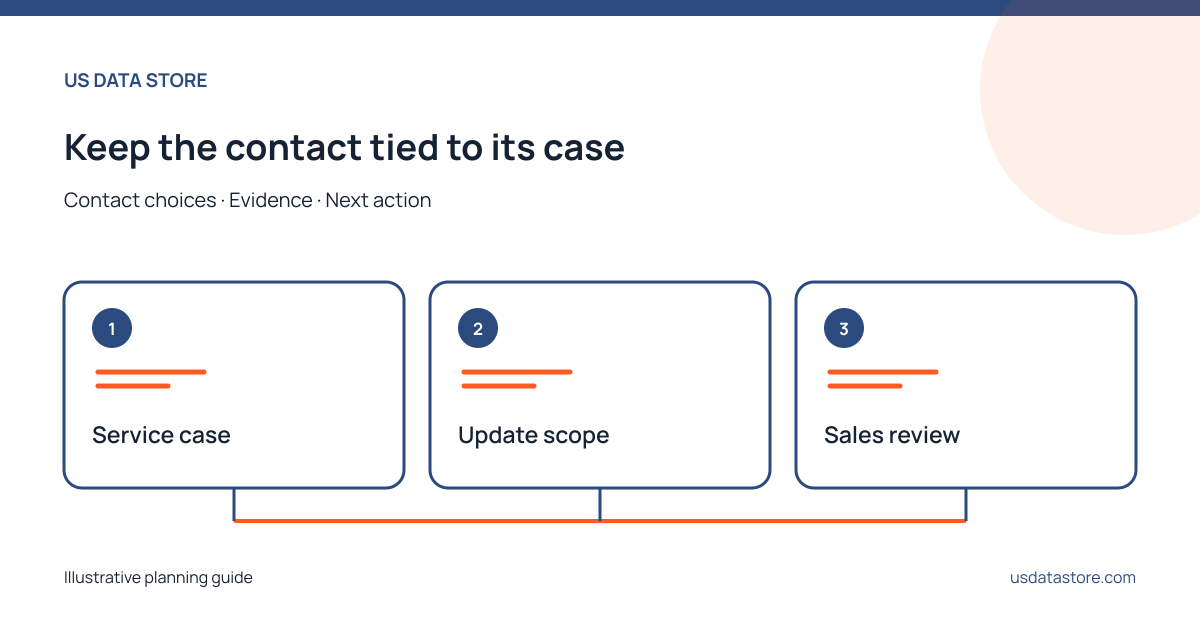
A service caller may give a direct number to resolve an open issue. That number should stay attached to the case and its requested next step. If an account team later wants to make a sales approach, it needs its own reviewed basis and should see any stated contact restriction.
Preserve the reason for contact
Record the company, case or request, named owner, and the channel the caller chose for updates. If a caller says the number is for urgent service only, carry that limitation into the handoff. Do not infer an SLA, approval to text, or a new sales opportunity from a support request.
Check the boundary at handoff
A service team may need to transfer a case, while an account team may want to discuss renewal or expansion. Write a separate decision for each purpose. Confirm who owns opt-outs and who can remove a number from an outbound list if the caller objects.
Work through one case
Illustrative: A warehouse supervisor supplies a mobile number for an open equipment-service request. Preserve “updates about this case” in the service handoff. If an account team wants to pitch an upgrade, it should review that separate purpose and any contact restrictions rather than copying the support number into a campaign.
B2B positioning is not a blanket exemption from calling or texting rules. Review the recipient, number, purpose, and technology instead of assuming that a work-related inquiry settles permission.
Apply the questions to this example
Illustrative worked example: These sample notes extend the case above. Roles and record locations are proposed for the example, not descriptions of a customer or this brand’s configured service. Adapt them to your own process.
| Step | Question | Sample evidence, owner, and next action |
|---|---|---|
| 1 | What case is open and who owns it? | Open equipment-service request; service owner retains the warehouse supervisor’s contact in that case. |
| 2 | What contact purpose did the caller authorize or request? | Updates about this case; preserve that scope instead of labeling the number as a general sales contact. |
| 3 | Who checks restrictions before a new sales approach? | Account owner: check the separate upgrade-outreach basis and restrictions before adding the number to a campaign. |
Put the next step in writing
Use this with the support and account boundary guide. Efficient routing is useful only if the receiving team understands the purpose of the contact.
Keep case communications within a reviewed purpose. This handoff example does not resolve the legal basis for a later account or sales campaign, even when the contact works for another business.
Further reading: FCC call and text guidance · FTC telemarketing resources.
Contact US Data Store to discuss the inbound workflow described on this site.